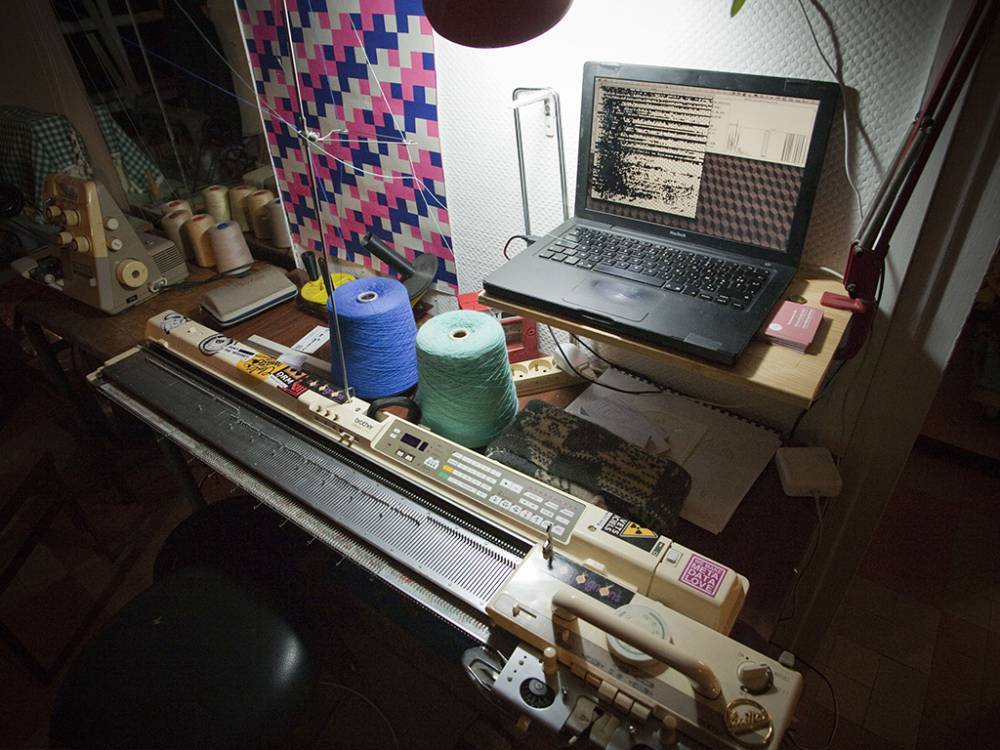
Sur les traces du projet Knitic et KnitHack, nous avons construit notre propre hack en récupérant des bouts de code des projets existants.
Notre premier objectif a été de tricoter des fichiers son pour enregistrer physiquement et visuellement des données audio dans le tricot.
Pour cela nous avons développé un logiciel pilote avec PureData qui nous permet d'enregistrer et tricoter des sons.
Since the 19th century, home knitting machines were a popular manufacturing tool which allowed knitters to produce rapidly knitted items to sell or for household crafts. The possibility to use jacquard patterns started with the use of punched hole cards and began to be computerised in the 80's. The immediate and low raw material resource needed to produce a knitted surface is what make knitting machines mobile and accessible for experimenting and prototyping. Since the late 80's these knitting machines have stopped been produced. These last years hackers and makers have started to open up knitting machines and found new ways to hack them by allowing the machines to be controlled directly by a modern computer. These hacked knitting machines become a sort of textile printer. Having a direct communication between digital tools and the knitting machine pushes the boundaries of traditional knitted patterns and gives us the opportunity to think of new way's in conceiving patterns.
In this workshop we will explore how our knitting machine can become a way of printing out (generated) data on a textile surface. First we will show how the monitoring system and the arduino controls the knitting machine as well as how the mechanics of the machine works in general. We will then experiment hands on with field recordings of our surrounding environment. Our sound cartography’s will then be translated and visualised with Pure Data and then sent to the machine to be knitted out. These patterns can be read as a visual translation of rhythms, silences and noises embedded in a palpable knitted surface.